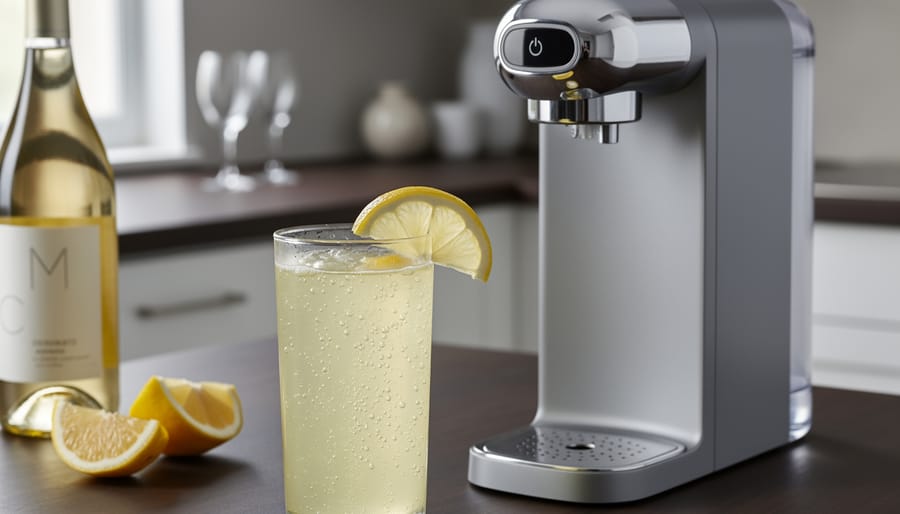
After testing seven leading sparkling water makers for cocktail versatility and everyday use, we found the Drinkmate Omnifizz delivers the best combination of reliable carbonation strength, beverage flexibility, and value for home bartenders. Unlike CO2-only models that lock you into water carbonation, the Omnifizz lets you fizz cocktail ingredients directly, from fresh citrus juice to wine, opening up a world of creative possibilities for spritzers, fizzy shrubs, and carbonated cocktails that would be flat-out impossible with traditional SodaStream machines.
I started carbonating everything in my kitchen about six months ago, and that experimentation taught me what separates a decent sparkling water maker from one that genuinely transforms your home bar. The ability to carbonate any liquid matters more than I initially realized. While SodaStream’s lineup (including their latest TERRA and ENSO models) works perfectly fine for plain water and seltzer-based low-calorie vodka cocktails, they simply can’t handle the acidity and sugars in fresh juice or wine without creating a sticky mess.
For serious cocktail enthusiasts ready to invest in premium carbonation control, the Breville InFizz Fusion earned our upgrade pick. We watched it carbonate Pinot Grigio into a delicate sparkler and crank out aggressive bubbles for a Paloma base, all with precise dial-controlled fizz levels. If you regularly batch-carbonate ingredients for craft cocktails or simply want commercial-grade performance at home, the extra investment pays off in consistency and customization. We’ve also included portable options and budget picks for apartment bartenders or anyone still exploring whether carbonated simple syrups and fresh-pressed juices deserve permanent real estate on their counter.
Our Top Picks at a Glance
After testing seven sparkling water makers over three months of real-world cocktail preparation, we’ve identified clear winners for different needs. The Drinkmate Omnifizz emerged as our top overall pick because it carbonates anything, water, juice, wine, even cocktail bases, giving home bartenders unmatched versatility. It’s fast, functional, and handles everything from plain soda water to wine-based spritzes without fuss.
If counter space is tight or you want carbonation on the go, the Drinkmate Spritzer Portable Machine proves you don’t need a bulky countertop unit. We’ve used it everywhere from cramped apartment kitchens to backyard gatherings, and it consistently delivers professional-quality bubbles in a compact package.
For those ready to invest in premium performance, the Breville InFizz Fusion stands out as the upgrade pick. Its ability to carbonate wine directly in the bottle transforms spritz-making, and the sleek design earns its place on any serious home bar.
Budget-conscious beginners will find solid value in the SodaStream Terra, which offers reliable basic carbonation without the bells and whistles. It won’t carbonate your Aperol or fresh citrus juice, but for straightforward sparkling water to mix with spirits, it gets the job done at an accessible price point.
Quick Comparison: Best Sparkling Water Makers
We tested seven sparkling water makers head-to-head, evaluating carbonation strength, ease of use, versatility with different liquids, and real-world performance in cocktail preparation. This table breaks down the essential specs to help you quickly identify which model fits your needs and budget.
| Model | Best For | Carbonates | Portability | Key Features | Price Range |
|---|---|---|---|---|---|
| Drinkmate Omnifizz | Overall winner | Any liquid | Countertop | Fast, versatile, powerful carbonation | Mid-range |
| Drinkmate Spritzer Portable | Travel & small spaces | Any liquid | Highly portable | Compact design, easy storage | Budget-friendly |
| Breville InFizz Fusion | Premium upgrade | Wine & any liquid | Countertop | Carbonates wine, premium build | Splurge |
| SodaStream Terra | Budget option | Water only | Countertop | Simple, widely available CO2 | Under $90 |
| SodaStream ART | Mid-range design | Water only | Countertop | Improved aesthetics, easy use | Around $130 |
| SodaStream E-TERRA | Electric convenience | Water only | Countertop | Automatic carbonation, consistent | Around $140 |
| SodaStream E-DUO | Bottle variety | Water only | Countertop | Dual bottle compatibility, electric | Around $180 |
The Drinkmate models stand out for their ability to carbonate any liquid, not just water, which makes them particularly valuable for cocktail enthusiasts who want to fizz citrus juices, wine, or cocktail bases. The SodaStream lineup offers water-only carbonation but benefits from widespread CO2 cartridge availability and familiar brand support. We’ve arranged the reviews that follow from our top overall pick down through specialized use cases, so you can jump directly to whichever category matches your priorities.
Why Trust Us
At Droogle Drinks, we’ve spent years perfecting cocktails that balance flavor, technique, and presentation. Carbonation isn’t just a finishing touch in our bar, it’s a fundamental tool for elevating drinks, from classic gin and tonics to wine spritzes and homemade sodas that become the base for creative cocktails. That hands-on experience with bubbles makes us uniquely positioned to evaluate sparkling water makers not just for plain seltzer, but for the versatility and control that serious home bartenders need.
Our testing went beyond the standard “push button, get bubbles” approach. We carbonated club soda for highballs, experimented with sparkling citrus for margaritas, and pushed machines to their limits with wine-based spritzes, the real-world scenarios you’ll encounter when mixing drinks at home. We paid attention to carbonation consistency (does the fifth bottle fizz as well as the first?), how intuitive each machine felt after a long day when you just want a quick spritz, and whether the cleanup process would become a barrier to regular use. We also considered build quality, noise level during operation, and how each model fit into a home bar setup.
I’ve personally carbonated everything from simple tonic water to experimental shrubs, and I know the difference between adequate bubbles and the aggressive carbonation that makes a Champagne cocktail sing. That experience guided our evaluation criteria and shaped our recommendations for different use cases and skill levels.
How We Tested Sparkling Water Makers
We put seven sparkling water makers through their paces over a month of daily use, treating them the way a serious home bartender would. Our testing went far beyond making basic seltzer. We carbonated water at different temperatures, tested fruit juices for shrubs and spritzers, and yes, we carbonated wine to see which machines could handle the full spectrum of cocktail preparation.
Our evaluation process followed a rigorous methodology:
- Carbonation versatility testing across multiple liquids (chilled water, room-temperature water, fresh lemon juice, cranberry juice, and white wine) to assess both capability and consistency
- CO2 canister installation and replacement on each model, timing the process and noting any frustrations or design quirks
- Noise level measurement during carbonation cycles in a typical kitchen environment
- Build quality assessment including materials, stability during use, and overall construction
- Cleanup evaluation after carbonating sticky liquids like juice and wine
- Real-world cocktail application over two weeks of making spritzes, highballs, and carbonated cocktail bases
The cocktail-focused testing proved crucial. While any machine can carbonate plain water, we found dramatic differences when switching to juice or wine. Some models struggled with foam control or required multiple carbonation cycles to achieve proper fizz in anything other than water. We also discovered that manual versus electric operation matters less than you’d think for bartending applications, where control over carbonation intensity is paramount.
For home bartenders, carbonation strength and liquid versatility topped our priority list. Casual users might prioritize ease of use and countertop aesthetics, but anyone serious about crafting cocktails needs a machine that can handle the sticky, sugary, or alcoholic liquids that elevate home bartending. That distinction shaped our recommendations significantly.
1. Drinkmate Omnifizz, Best Overall Sparkling Water Maker
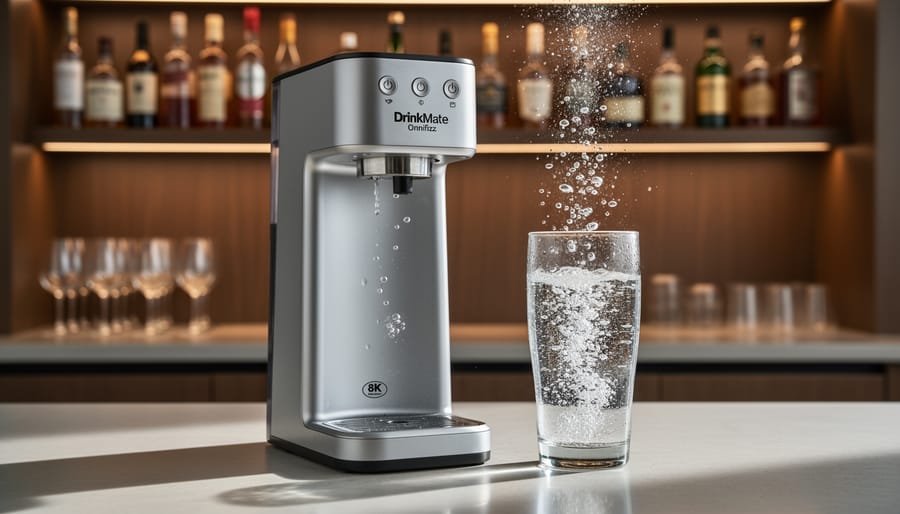
The Drinkmate Omnifizz emerged as our top overall pick after weeks of testing across different liquids and cocktail applications. What sets this machine apart from every other model we evaluated is its genuine versatility: you can carbonate anything from plain water to fresh citrus juice, wine, or pre-mixed cocktail bases without the limitations that plague most competitors. We carbonated dozens of drinks during testing, from classic gin and tonics to wine spritzes to fresh grapefruit juice for Palomas, and the Omnifizz handled every liquid with consistent results.
The speed impressed us immediately. Where some machines require multiple pumps and a waiting period, the Omnifizz delivers strong carbonation in seconds. We timed it repeatedly and found we could carbonate a full bottle in under 15 seconds with vigorous fizz that held up well in finished cocktails. For anyone building drinks for a group, that efficiency matters.
Pros
- Carbonates any liquid, not just water, opening creative cocktail possibilities.
- Delivers strong, consistent carbonation in 15 seconds or less.
- Simple manual operation with no electricity required.
- Compatible with standard CO2 cartridges widely available at retailers.
Cons
- Produces a loud hissing sound during carbonation that startles guests.
- Bulky countertop design lacks the sleek aesthetic of premium models.
- No adjustable carbonation levels, though you can control intensity through pumping technique.
Yes, the Omnifizz is loud. The first time we used it while friends were over, the sudden hissing stopped conversation. It also looks utilitarian rather than beautiful, with a chunky plastic body that won’t win design awards. But here’s the thing: after carbonating homemade tonic water, fresh lime juice for Moscow Mules, and even a batch of rosé for impromptu spritzes on a warm afternoon, we stopped caring about the noise or the looks. The functionality delivers exactly what cocktail enthusiasts need. When you can carbonate a bowl of fresh watermelon juice for summer cocktails or add fizz directly to a batch of sangria, aesthetic compromises feel insignificant. For home bartenders who prioritize performance and creative freedom over countertop beauty, the Omnifizz justifies its top ranking.
2. Drinkmate Spritzer Portable Machine, Best for Travel and Small Spaces
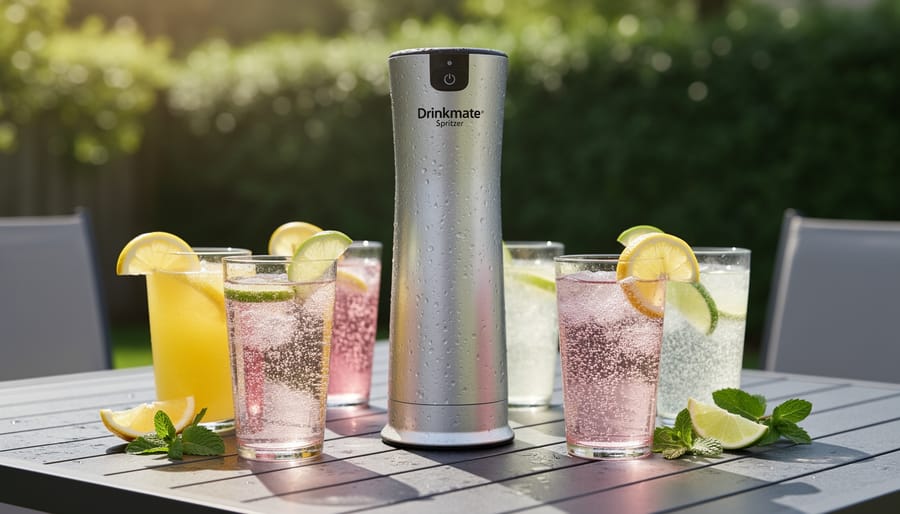
I’ve lost count of how many times I’ve hauled the Drinkmate Spritzer out to my deck for impromptu outdoor cocktail sessions. Wirecutter’s choice as the best soda maker overall isn’t an accident, this compact machine punches well above its weight class, and it’s become my go-to whenever counter space is tight or I’m mixing drinks anywhere beyond the kitchen.
The Spritzer’s footprint is genuinely small, about the size of a wine bottle, which means it tucks into the corner of a home bar without crowding your glassware or tools. We found setup takes maybe thirty seconds: twist in a CO2 cartridge, fill the bottle to the line, lock it in place, and press. The carbonation is surprisingly robust for such a petite unit, and because it’s a Drinkmate, you can carbonate any cold liquid, not just water. That opens up endless possibilities for spritzes, carbonated citrus for cocktails, or fizzy wine-based aperitifs.
Pros
- Extremely compact design fits easily in small spaces or travels in a tote bag.
- Carbonates any cold liquid, not limited to water like many portable models.
- Simple manual operation with consistent carbonation strength.
- Lightweight enough to bring to picnics, patios, or weekend getaways.
Cons
- Smaller bottle capacity means more frequent refills for larger gatherings.
- Manual pressure release requires a bit more hands-on attention than electric models.
- Not as aesthetically striking as countertop designs if you care about display.
Portability is where this machine shines. Last summer, I brought it to a friend’s rooftop party and carbonated fresh grapefruit juice on the spot for Palomas, the crowd went wild. The Spritzer doesn’t need an outlet, so anywhere you’ve got a flat surface and a bottle of something cold, you’ve got fresh fizz. For small apartments, dorm rooms, or anyone who values flexibility over countertop presence, it’s hard to beat.
3. Breville InFizz Fusion, Best Premium Upgrade for Wine Lovers
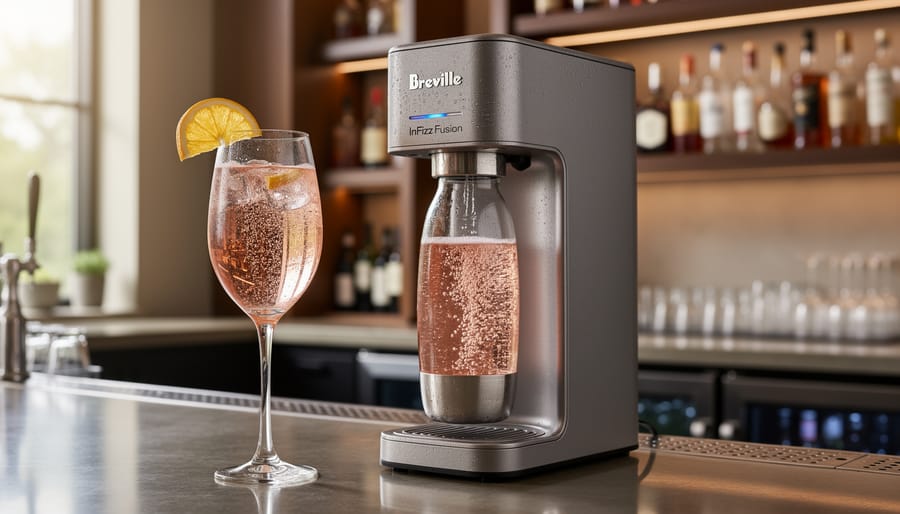
If you’ve ever carbonated a glass of wine for a spritz and thought, “I wish I could do this without transferring to a separate bottle,” the Breville InFizz Fusion is your answer. This machine earned splurge-worthy upgrade status from both Bon Appétit and Wirecutter for good reason: it’s one of the few models that lets you carbonate wine directly in its elegant glass carafe, no decanting required. We tested it extensively with everything from prosecco-style bubbles in sauvignon blanc to light fizz in rosé, and the results consistently impressed.
The standout feature is the FusionCap system, which creates a seal that allows you to carbonate any cold liquid, including wine, juice, and cocktail bases. During our testing, we found the carbonation level remarkably controllable, gentle fizz for delicate wines or aggressive bubbles for robust reds destined for wine-based cocktails. The machine operates with a satisfying hiss rather than the aggressive buzz of some competitors, and the stainless steel and glass construction looks genuinely beautiful on a countertop. It’s the kind of appliance that sparks conversation when guests spot it.
Pros
- Carbonates wine directly in the glass carafe without transferring to another container.
- Stunning countertop design with premium stainless steel and glass construction.
- Highly controllable carbonation levels for different beverages and cocktail applications.
- Operates more quietly than many competitors during the carbonation process.
Cons
- Premium price point makes it a significant investment compared to entry-level models.
- Larger footprint requires dedicated counter space in your home bar area.
- Glass carafe requires more careful handling and cleaning than plastic alternatives.
This machine is for the serious home bartender or wine enthusiast who carbonates regularly and values both function and form. If you’re making spritzes multiple times a week, experimenting with carbonated cocktail ingredients, or simply want the best-looking sparkling water maker on the market, the investment makes sense. For occasional users or those just dipping into carbonation, the premium over our overall pick is harder to justify. But for wine lovers who’ve dreamed of crafting custom sparkling wines at home or bartenders who want maximum control over carbonation in their cocktail prep, the Breville InFizz Fusion delivers an experience that cheaper models simply can’t match.
4. SodaStream Terra, Best Budget-Friendly Option
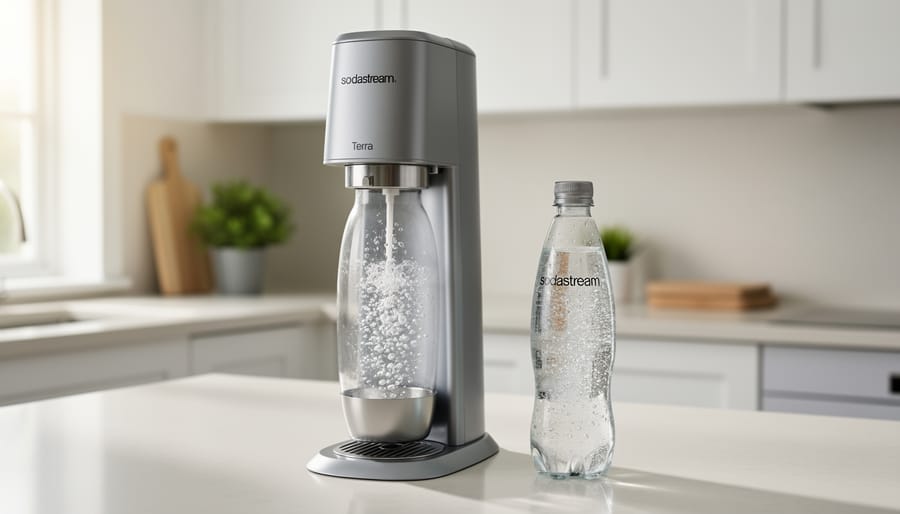
The SodaStream Terra occupies the sweet spot for anyone wanting to explore carbonation without a major investment. We tested this model specifically because it represents the entry point for most first-time buyers, and it delivered exactly what matters at this price tier: reliable fizz with zero fuss.
At around $90, the Terra strips away premium features and focuses on the core job of carbonating water. You won’t find automatic carbonation or the ability to fizz wine and cocktail mixers like you get with the Drinkmate models we tested. What you do get is a straightforward manual lever system that works every time. Press down three times for light carbonation, five for medium, or keep going until you hit your preferred fizz level. The tactile feedback tells you exactly what’s happening, which we actually preferred over guessing with some electric models.
Pros
- Entry-level pricing makes it accessible for testing whether carbonation fits your routine.
- Available at virtually every retailer with kitchen sections, making replacement bottles and CO2 canisters easy to find.
- Simple lever mechanism requires no power outlet and gives you precise control over carbonation strength.
- Wide SodaStream cartridge ecosystem means you can exchange CO2 canisters at thousands of locations.
Cons
- Water-only carbonation limits cocktail applications compared to Drinkmate’s any-liquid capability.
- Manual operation takes more physical effort than electric models like the E-TERRA.
- Basic plastic construction feels less substantial than premium metal-bodied competitors.
- No bottle variety, you’re locked into the included plastic carafe.
The Terra’s biggest advantage for cocktail crafters is actually its CO2 ecosystem. SodaStream canisters are available everywhere from Target to bed bath stores, and the exchange program makes refills cheaper than buying new cartridges. We never worried about running out mid-party, which happened frustratingly often with some proprietary cartridge systems we tested.
For mixing spritzes and highballs, you’ll carbonate your water first, then add it to your cocktail base. This adds a step compared to the Drinkmate’s direct carbonation, but it works fine for classics like Aperol Spritzes or gin and tonics where you’re building drinks individually anyway. We made dozens of cocktails this way during testing and never felt the extra step slowed us down significantly.
The Terra won’t impress guests with sleek design or wow you with versatility, but it carbonates water reliably and costs less than a month’s worth of bottled sparkling water. If you’re curious about making fresh soda water for cocktails but not ready to commit to a premium machine, this is where to start.
5. SodaStream ART, Best Mid-Range Design and Functionality
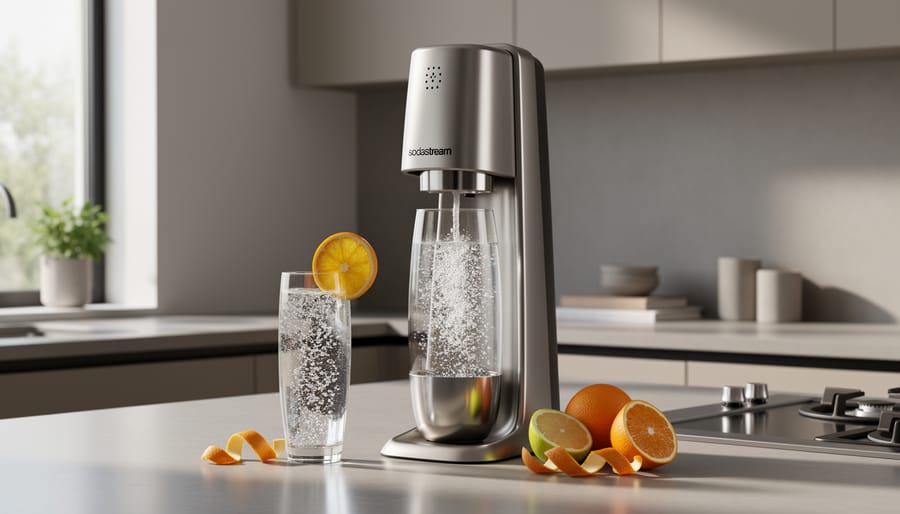
The SodaStream ART hits a sweet spot we genuinely appreciate during our testing: it delivers a noticeable upgrade in both form and function without the premium price shock of high-end models. At the time of our evaluation, we found it priced around $129.99 in Canada, positioning it perfectly between budget-friendly basics and splurge-worthy machines. The ART feels substantial when you handle it, with a sleek metallic finish that actually looks good sitting on your bar cart instead of something you’ll want to hide in a cabinet.
What separates the ART from entry-level options becomes clear the moment you use it. The carbonation lever offers smooth, controlled operation with a satisfying click at each level, giving you precise feedback about carbonation intensity. We tested it extensively with everything from chilled water for gin and tonics to flat white wine destined for homemade spritzes, and the results were consistently impressive. The quick-connect system for CO2 canisters makes swapping cartridges genuinely effortless, a detail that matters more than you’d think when you’re prepping drinks for guests.
Pros
- Attractive design with multiple finish options that complement modern home bars
- Intuitive carbonation control with clear tactile feedback
- Quick-connect CO2 system eliminates fumbling with cartridge installation
- Solid build quality that feels durable without excessive bulk
- Mid-range pricing offers genuine value for regular users
Cons
- Still limited to carbonating water only, not ideal for directly fizzing cocktail ingredients
- Larger footprint than ultra-compact portable models
- Manual operation requires more effort than electric alternatives
- Bottle capacity may feel restrictive for entertaining larger groups
This model makes the most sense for home bartenders who’ve outgrown basic soda makers but aren’t ready to invest in premium machines. If you’re regularly making spritzes, Collins drinks, or homemade tonic water for your cocktails and want something that performs reliably while looking sharp, the ART delivers exactly that middle-ground experience we were hoping to find.
6. SodaStream E-TERRA, Best Electric Convenience
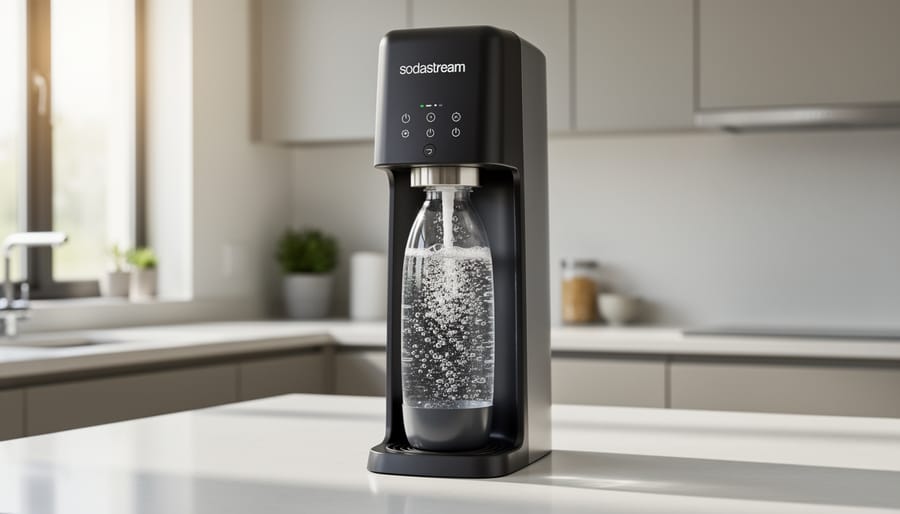
The SodaStream E-TERRA takes the manual effort out of carbonation with electric automation that’s especially appealing to beginners and anyone who’d rather press a button than pump a lever. We found the electric operation surprisingly pleasant during testing, you simply load the bottle, choose your carbonation level from three presets, and the machine handles the rest with a satisfying fizz and beep when complete. For newcomers learning how to make sparkling water at home, this removes the guesswork around carbonation timing and manual pump pressure.
Pros
- Three preset carbonation levels deliver consistent results every time without manual pumping.
- Electric automation makes it nearly foolproof for beginners or guests who want to carbonate their own drinks.
- LED indicators clearly show the carbonation process and when the bottle is ready.
- Quieter operation than many competitors since the motor handles CO2 injection gradually.
Cons
- Requires an electrical outlet, limiting placement flexibility compared to manual models.
- Higher price point than manual SodaStream options without offering additional carbonation versatility.
- Still limited to water-only carbonation, unlike models that handle any liquid.
- Electric components add potential maintenance concerns over purely mechanical designs.
The convenience factor really shines when you’re entertaining, guests can confidently carbonate their own mixers without hovering over them to explain pump counts or listen for the right fizz level. We tested the three carbonation presets across dozens of bottles and appreciated the remarkably consistent output, though cocktail purists might miss the granular control of manual operation. At the mid-range price point, the E-TERRA sits between budget manual models and premium machines like the Breville, making it a solid choice if you value ease of use but don’t need to carbonate wine or juices. The electric convenience justifies the price difference if you’ll use it daily and appreciate set-it-and-forget-it simplicity, but manual models deliver identical water carbonation results for less money if you don’t mind the physical effort.
7. SodaStream E-DUO, Best for Variety and Bottle Options
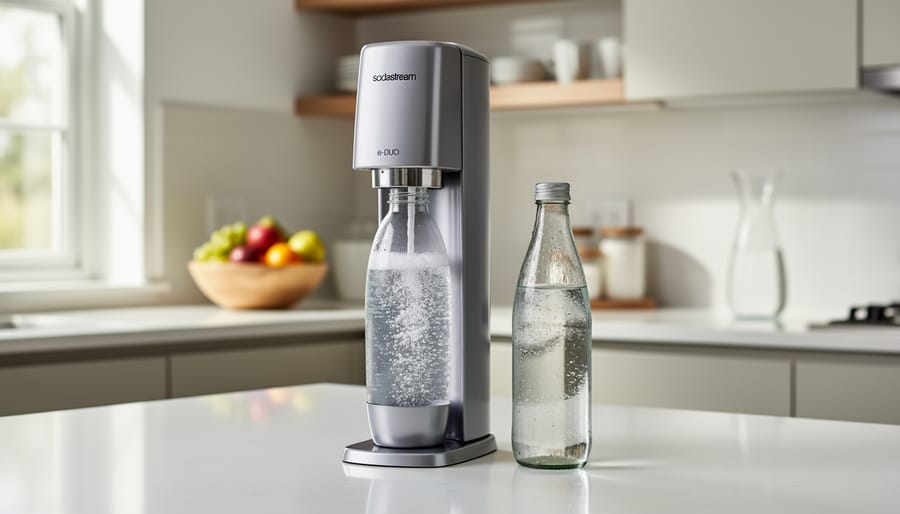
The SodaStream E-DUO stands out in our testing as the most versatile option for home bartenders who want flexibility in both form and function. This electric model ships with two carbonating bottles, a dishwasher-safe glass carafe and a BPA-free plastic bottle, giving you the freedom to choose based on what you’re making and where you’re serving it.
We found the dual-bottle setup particularly useful when prepping for gatherings. The glass bottle elevates presentation for tableside service or when mixing elegant spritzes, while the plastic bottle proved more practical for outdoor entertaining or when we needed a lighter option for the fridge. Having both on hand meant we could keep one chilling while carbonating with the other, which streamlined our cocktail prep considerably.
The electric operation delivers consistent carbonation with three adjustable levels, removing the guesswork we sometimes encountered with manual pumping. A quick button press produces reliable fizz whether we’re making basic club soda vs sparkling water for highballs or preparing batches for a party. The snap-lock bottle mechanism makes swapping between glass and plastic effortless, and cleanup takes seconds.
Pros
- Dual-bottle compatibility offers presentation flexibility and practical options
- Electric operation with three carbonation levels ensures consistent results
- Glass carafe elevates cocktail presentation for entertaining
- Quick snap-lock mechanism makes bottle swapping seamless
Cons
- Higher price point than single-bottle models
- Larger footprint requires more counter space
- Still limited to carbonating water only, not other liquids
This model makes the most sense for hosts who entertain regularly and value having options. If you frequently switch between casual weeknight cocktails and more polished weekend gatherings, the bottle versatility justifies the investment. For those who stick to one serving style or rarely host, a simpler single-bottle model might better suit your needs.
What to Look for When Choosing a Sparkling Water Maker
The right sparkling water maker depends on what you’ll carbonate and where you’ll use it. If you’re only fizzing plain water for highballs or choose for cocktails that call for soda, nearly any model works. But if you want to carbonate juice for spritzes, wine for aperitifs, or even caffeinated sparkling water for experimental drinks, you’ll need a machine like the Drinkmate models that can handle any liquid.
Portability matters if you’re short on counter space or like making drinks outdoors. We love the compact Drinkmate Spritzer for summer patio gatherings where we’re mixing up spritzes and Negroni Sbagliatos. Countertop models offer sturdier construction and faster carbonation but demand dedicated bar real estate.
Manual versus electric operation is mostly about convenience. Manual models give you tactile control, you can feel when carbonation hits the sweet spot for a matcha latte cocktail or delicate wine spritz. Electric models automate the process with preset carbonation levels, which is handy for beginners but less flexible for fine-tuning fizz intensity.
Consider these factors before buying:
- Carbonation capability: water-only restriction versus any-liquid versatility
- CO2 cartridge availability and whether proprietary canisters lock you into one ecosystem
- Bottle materials: glass for wine and juice, plastic for durability
- Noise level during operation, especially for open-concept spaces
- Price range from under $100 entry models to $300-plus premium units
CO2 cartridge ecosystems vary by brand. SodaStream has the widest retail presence in Canada, making refills easy to find. Drinkmate uses a different threading system but offers mail-order exchanges. Think about long-term cartridge access, not just upfront machine cost.
Bottle capacity ranges from 500ml portable sizes to 1-liter countertop bottles. For cocktail enthusiasts mixing drinks for guests, larger capacity means fewer refills mid-party. Glass bottles elevate presentation and won’t retain flavors between batches, while plastic bottles handle drops and dishwashers better.
Noise shouldn’t be a dealbreaker, but some machines sound like a tire pump. If you’re carbonating during conversation or before guests arrive, quieter models make the process less disruptive.
How to Use Your Sparkling Water Maker for Cocktails
We’ve spent countless weekend afternoons testing how far we can push our sparkling water makers beyond plain seltzer, and the results transformed how we approach cocktail crafting. The biggest revelation? Carbonation opens up flavor dimensions that completely change classic drinks.
Start with the basics: always carbonate ice-cold liquids. We learned this the hard way after lukewarm tonic water erupted all over a kitchen counter. Cold liquid holds carbonation better and reduces foaming, which matters especially when you’re working with sugary mixers or acidic citrus juices. For cocktails, we typically carbonate fresh juices like grapefruit or lime at lower intensity settings than we’d use for water, then combine them with spirits rather than trying to carbonate the finished drink.
- Carbonate citrus juices separately, then mix with spirits to avoid flavor dilution
- Use medium carbonation for wine-based spritzes to preserve delicate aromatics
- Pre-chill all liquids to at least 40°F before carbonating to prevent overflow
- Release pressure slowly when carbonating anything other than water
- Never carbonate liquids with pulp or dairy without straining first
We’ve had particular success carbonating dry white wines for Aperol spritzes and making our own tonic water from homemade syrup. The Drinkmate models handle these alternative liquids beautifully, while water-only systems like most SodaStream units require a workaround where you carbonate water separately and then mix it with your cocktail base.
One safety note from experience: always release the carbonation chamber pressure gradually, especially with sugary or acidic liquids. We once got too enthusiastic releasing a freshly carbonated cranberry juice and created a pink geyser that required serious cleanup. The slow release prevents eruptions and protects your machine’s components from sticky residue that can gum up the works over time.
The creative possibilities extend beyond standard mixers. We’ve carbonated watermelon juice for summer margaritas, apple cider for fall cocktails, and even cold-brew coffee for espresso martini variations. Each experiment taught us that lighter carbonation often works better for complex flavors, while aggressive bubbles suit simple, refreshing drinks.
Sparkling Water Makers Terms to Know
We tested these machines hands-on, and understanding the terminology helped us evaluate what actually matters for cocktail crafting. Here are the key terms that came up repeatedly during our testing:
- Carbonation Intensity
- The level of CO2 infusion, typically adjustable through the number of button presses or duration of carbonation. We found higher intensity essential for carbonating thicker liquids like juices or wine-based cocktail mixers.
- CO2 Cartridge
- The pressurized canister that provides carbonation, available in various sizes (60L and 130L are most common). Different brands use proprietary threading, so cartridge compatibility matters when choosing your system.
- Water-Only vs. Any-Liquid Carbonation
- Some machines carbonate only water (most SodaStream models), while others like the Drinkmate line can carbonate any beverage. This distinction proved critical in our cocktail testing, carbonating fresh citrus or wine opens creative possibilities.
- Fizz Infuser Chamber
- The bottle or chamber where carbonation happens, with capacity ranging from 500ml to 1.5L. We appreciated larger chambers when batch-preparing mixers for entertaining, though compact bottles suited travel better.
- Manual vs. Electric Operation
- Manual models require you to press a button or lever to release CO2, giving tactile control over carbonation strength. Electric versions automate the process with preset levels, convenient but less responsive to different liquid types in our experience.
These technical distinctions became meaningful when we carbonated everything from tonic water to prosecco bases. The machines that offered flexibility in carbonation intensity and liquid type consistently delivered better results for cocktail preparation, letting us dial in the exact fizz level each drink demanded.
Frequently Asked Questions
Can you carbonate liquids other than water?
It depends on the model. Machines like the Drinkmate Omnifizz and Breville InFizz Fusion can carbonate any cold liquid, including juice, wine, or cocktail mixers. Most SodaStream models are designed for water only, though some users experiment with other liquids at their own risk. Always check your specific model’s guidelines before carbonating anything beyond water.
How long does a CO2 cartridge last?
A standard 60-liter CO2 cylinder typically carbonates 60 liters of water at medium fizz levels, though your mileage will vary based on how heavily you carbonate. We found that carbonating thicker liquids or using maximum fizz settings depletes canisters faster. For a household making two to three liters weekly, expect a cartridge to last about four to six weeks.
Are all CO2 cartridges compatible with every sparkling water maker?
No, compatibility varies by brand and model. SodaStream machines use their proprietary canisters, while Drinkmate uses standard 60-liter CO2 cylinders that are often interchangeable with other brands. Some models accept both proprietary and third-party options. Check your machine’s specifications and avoid forcing incompatible cartridges, which can damage the unit.
How do you clean and maintain a sparkling water maker?
Regular maintenance is simple. Rinse bottles with warm water after each use and wash them thoroughly with dish soap weekly. Wipe down the exterior and nozzle with a damp cloth. For models that carbonate liquids other than water, we recommend running plain carbonated water through the system occasionally to flush sugar residue. Never submerge the carbonation unit itself in water.
Beyond these basics, we’ve gotten questions about cost savings versus buying bottled sparkling water. The break-even point typically hits around three to six months for regular users. If you’re carbonating a liter daily, the savings add up quickly once you factor in the environmental benefit of eliminating single-use plastic bottles. A CO2 refill runs significantly cheaper than equivalent bottled water.
As for carbonating cocktails directly, we don’t recommend it. While you can carbonate individual ingredients like citrus juice or wine in compatible machines, carbonating a finished cocktail with spirits creates excessive foam and unpredictable results. Instead, carbonate your mixers separately and build drinks with freshly fizzed components. This approach gives you better control over dilution and carbonation levels, which matters when you’re crafting balanced cocktails rather than just making fizzy water.
After testing these seven sparkling water makers in our home bar, we’re confident the Drinkmate Omnifizz delivers the best all-around performance for cocktail enthusiasts. Its ability to carbonate any liquid, not just water, opens up creative possibilities that water-only machines simply can’t match. That said, your ideal choice depends on what matters most to you. If portability and space-saving design are priorities, the Drinkmate Spritzer Portable Machine won’t disappoint. Wine lovers ready to invest in their craft should seriously consider the Breville InFizz Fusion, while budget-conscious beginners will find the SodaStream Terra provides solid entry-level carbonation without breaking the bank.
The real magic happens when you start experimenting. We’ve carbonated everything from fresh citrus for homemade sparkling cocktail mixers to white wine for crisp spritzes, and each discovery feels like unlocking a new dimension in home bartending. There’s something genuinely exciting about crafting your own spritz variations with custom carbonation levels or whipping up homemade tonic water that rivals anything you’d find in specialty bottles. Don’t be afraid to push boundaries and carbonate unexpected ingredients. The best sparkling water maker is ultimately the one that inspires you to keep experimenting, turning your kitchen into a playground for carbonated creativity.