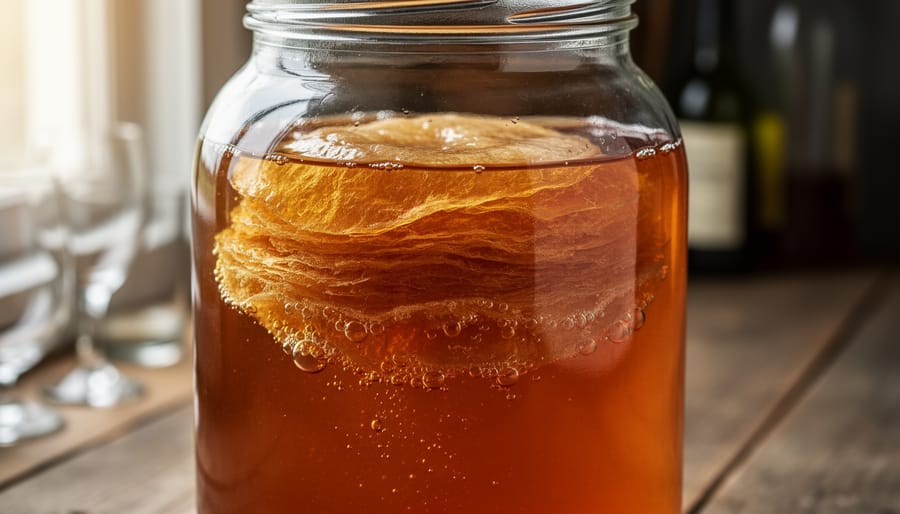
Kombucha is a fermented tea beverage made by culturing sweetened tea with a symbiotic culture of bacteria and yeast, often called a SCOBY. While you’ve probably seen it dominating cooler shelves everywhere and maybe even experimented with it in your cocktails, the true origin story of this fizzy, tangy drink remains surprisingly elusive. The real origin of kombucha could be as old as 5,000 years or as young as 200, and pinpointing where and when it first appeared is far from straightforward.
Most evidence points to kombucha likely originating in China before spreading along the Silk Road with tea traders, though some accounts place its early popularity in Russia and Ukraine during the late 1800s. Here’s what makes the history so murky: the first kombucha was probably born by accident, someone’s forgotten cup of sweetened tea that picked up wild bacteria and yeast, transformed into something unexpectedly delicious, and became worth replicating.
For those of us behind the bar in 2026, understanding kombucha’s foggy past matters less than appreciating what it brings to modern drinks. This article cuts through the legends and unverified claims to explore what we actually know about kombucha’s journey from ancient accident to contemporary cocktail ingredient, helping you appreciate the cultural depth behind that bottle of GT’s or your homemade brew.
What Kombucha Actually Is
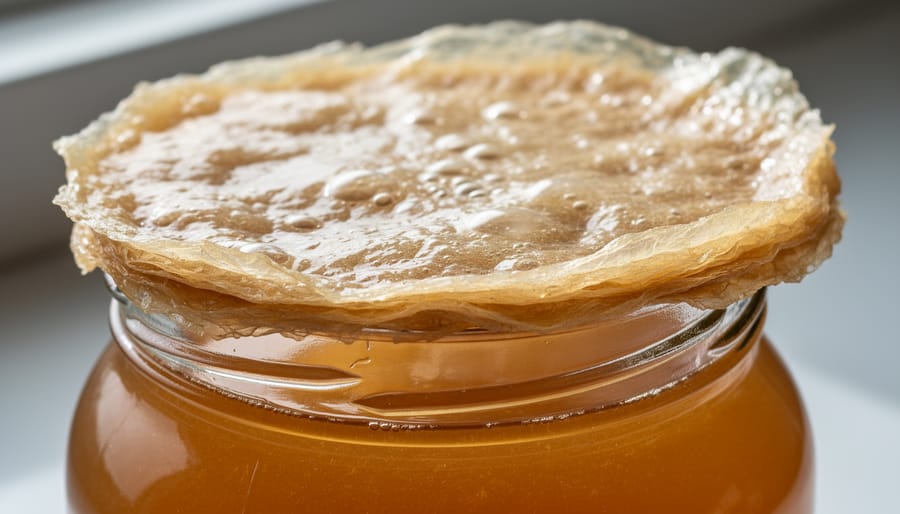
At its simplest, kombucha is a fermented tea drink created when sweetened tea mingles with a living culture of bacteria and yeast. This culture, known as a SCOBY (symbiotic culture of bacteria and yeast), transforms ordinary tea into something entirely different over the course of several days.
The process itself is straightforward enough that it could have happened by accident centuries ago. You start with brewed tea, black, green, or another variety, add sugar, let it cool to room temperature, then introduce the SCOBY. This rubbery, pancake-like disk floats on the surface and gets to work. The bacteria and yeast consume the sugar, producing organic acids, a bit of alcohol, carbon dioxide, and a new layer of cellulose that thickens the SCOBY with each batch.
- SCOBY
- A symbiotic culture of bacteria and yeast that ferments sweetened tea into kombucha. It’s a living ecosystem rather than a single organism.
- Cellulose pellicle
- The rubbery, disk-shaped mat that forms on the surface during fermentation, sometimes called the “mother” or mushroom (though it’s not actually fungal).
- Tea fungus
- A common nickname for the SCOBY, despite the fact that it contains no actual fungi, just bacteria and yeast working together.
- Acetic acid bacteria
- The bacterial component of the SCOBY responsible for producing the tangy, vinegar-like acids that give kombucha its characteristic sharpness.
- Fermentation
- The metabolic process where microorganisms break down sugars, transforming sweet tea into a fizzy, tangy, slightly alcoholic beverage over several days at room temperature.
After about a week at ambient temperature, you’re left with a sparkling, tangy drink that walks the line between sweet and sour. The cellulose pellicle SCOBY creates not just flavor complexity but also a new mat that can be passed along to start another batch, which explains how kombucha spread from culture to culture long before anyone understood microbiology.
Understanding this simple production method is key to making sense of kombucha’s murky history. A drink that requires only tea, sugar, ambient temperature, and a self-perpetuating starter culture could have emerged almost anywhere tea was consumed, and that geographic flexibility is exactly why pinpointing its origin proves so maddeningly difficult.
How Kombucha Fermentation Works
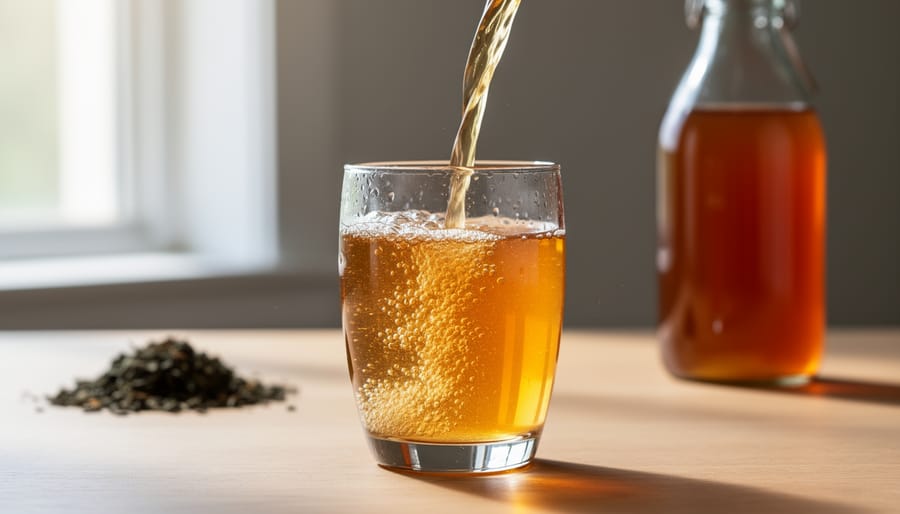
The magic of kombucha happens when you combine sweetened tea with a SCOBY, that gelatinous disk floating in your starter liquid. Over the course of a week or two (depending on temperature), the bacteria and yeast work together to transform plain sweet tea into something entirely different: tart, lightly effervescent, and complex in flavor.
Here’s what happens during fermentation:
- Sweetened tea provides the food source, usually black or green tea with white sugar dissolved in it
- The SCOBY introduces both acetic acid bacteria and various yeast strains into the liquid
- Yeasts consume the sugar and produce alcohol and carbon dioxide
- Bacteria convert the alcohol into acetic acid and other organic acids, creating kombucha’s signature tang
- The whole process occurs fermented at ambient temperature, typically between 68-78°F
- Natural carbonation builds as the fermentation progresses, giving kombucha its gentle fizz
This symbiotic relationship is what makes kombucha special. The bacteria and yeast don’t just coexist, they actively support each other. Yeast creates alcohol that bacteria need, while bacteria produce an acidic environment that protects the brew from harmful microorganisms. It’s a self-regulating ecosystem in a jar.
What makes this process historically significant is its simplicity. You don’t need precise temperature control, specialized equipment, or even a clear understanding of microbiology. If someone in ancient China left sweetened tea sitting out and wild yeasts and bacteria colonized it, the first kombucha could have emerged entirely by accident. The fact that it tastes good and keeps well (thanks to its acidity) would have encouraged people to reproduce it intentionally.
If you’re curious about trying this yourself, our 7-step kombucha guide walks through the entire process. Understanding how fermentation works also helps you troubleshoot batches and experiment with flavors once you’ve mastered the basics.
The Mystery of Kombucha’s Origins
Tracking down kombucha’s actual birthplace feels a bit like chasing a ghost through a fog. The history of kombucha dates back anywhere from 5,000 years to as recently as 200 years ago, depending on which claims you follow. That’s a staggering range, and it highlights just how little solid documentation exists.
The problem isn’t just missing records. Multiple regions claim kombucha as their own. Some sources point to China, others to Russia and Ukraine in the late 1800s, and still others suggest various points along the Silk Road where tea and fermentation knowledge intersected. Each region has fermented tea traditions that could plausibly be kombucha’s ancestor, or could be parallel developments that never touched the original lineage.
Add to this the fact that fermented beverages pop up independently across cultures. Ancient peoples discovered fermentation accidentally in countless places, often with similar results. When you’re dealing with something as simple as sweetened tea left to ferment at room temperature, it’s entirely possible that multiple cultures stumbled onto kombucha-like drinks without any connection to each other. There’s no smoking gun, no ancient recipe carved in stone, no clear paper trail leading back to a single moment of discovery.
What we’re left with is a patchwork of possibilities rather than certainties. The kombucha in your glass today connects to an ancient tradition, but pinpointing exactly where that tradition began remains frustratingly out of reach.
Theories About Where Kombucha Began
The Ancient China Connection
The most widely supported theory points to ancient China as kombucha’s birthplace. This makes intuitive sense: China is the undisputed origin of tea itself, and fermentation practices flourished there for millennia. As tea cultivation spread westward along trade networks, the knowledge of fermenting it likely traveled too. According to Britannica, kombucha probably originated in China and spread along the Silk Road with tea, carried by merchants and travelers who valued fermented drinks for their keeping qualities and perceived health benefits.
Yet we should be honest about what we don’t know. No ancient Chinese text definitively describes kombucha as we recognize it today, and claims about specific early references remain unverified. The China connection rests on logical inference rather than archaeological proof, a compelling hypothesis that fits the evidence we have, even if it can’t be conclusively proven. For modern enthusiasts exploring fermented tea in cocktail mixer ideas this uncertainty only adds to kombucha’s mystique.
The Accidental Discovery Story
Picture this: someone in ancient times brewed tea, sweetened it with honey or sugar, then forgot about the cup for a few days. Wild yeasts drifting through the air landed on the liquid’s surface, joined by ambient bacteria. Together, they formed a translucent film and began their symbiotic work, fermenting the sweet tea into something fizzy, tangy, and entirely new.
This accidental discovery theory holds particular appeal because it mirrors how we stumbled upon so many fermented foods. Nobody set out to invent cheese, sourdough bread, or wine. These transformations happened when the right ingredients met the right microbes under the right conditions, usually when someone left food sitting around longer than planned. Kombucha fits this pattern perfectly: sweetened tea left at room temperature creates ideal conditions for spontaneous fermentation. The first SCOBY likely formed naturally, without anyone understanding the microbiology at work.
Whether this happy accident occurred once or independently in multiple places remains unknown, but it’s a compelling narrative that explains how such a simple process could predate written records.
The Eastern European Documentation
The most concrete historical evidence we have for kombucha comes from late 1800s Russia and Ukraine where the fermented tea drink was well-documented in household use. While these records don’t prove the drink originated there, they represent the earliest reliable written references to a beverage matching kombucha’s description. Russian and Ukrainian communities brewed it as a health tonic, passing the SCOBY from family to family in a tradition that continues today. This documentation gap matters: everything before the late 1800s relies on theories and secondhand claims rather than verifiable sources, which is why we can’t confidently trace kombucha back further despite the compelling ancient origin stories.
Why Kombucha Fits the Cocktail Culture
After exploring kombucha’s murky past, let’s connect those ancient fermentation techniques to what matters for today’s cocktail enthusiasts: this fizzy tea brings something genuinely different to the bar.
I stumbled onto kombucha as a mixer by accident at a friend’s garden party three summers back. She’d run out of tonic and grabbed a bottle of ginger kombucha instead for our gin. That improvised cocktail, bright, layered, with a funkiness that regular mixers couldn’t touch, opened my eyes to what fermented tea could do in a glass.
Understanding kombucha’s origins as a naturally fermented beverage helps explain why it works so brilliantly in mixology. That SCOBY-driven fermentation creates complexity that manufactured sodas simply can’t replicate. The bacterial and yeast cultures produce organic acids, subtle funkiness, and depth that complement spirits rather than just sweetening them.
Here’s what kombucha brings to cocktail culture:
- Natural carbonation without artificial bubbles or added CO2
- Complex flavor layers from fermentation, tartness, sweetness, and umami notes
- Probiotic appeal for health-conscious drinkers seeking functional cocktails
- Tea-based botanical notes that pair beautifully with gin, vodka, and rum
- Low-ABV mixer options that let you craft sessionable drinks
The fermented tea foundation also means kombucha carries tea’s natural compounds and botanical character. When you mix with kombucha, you’re not just adding fizz, you’re layering in centuries of tea culture and fermentation craft. Plus, if you’re wondering is kombucha caffeinated the answer matters for evening cocktails: it typically contains less caffeine than coffee but enough to keep your drinks interesting without being a stimulant bomb.
Common Questions About Kombucha’s Origins
How old is kombucha?
Estimates vary wildly, from as ancient as 5,000 years to as recent as 200 years. The truth is we don’t have definitive documentation to pin down exactly when kombucha first appeared, which is why the range is so broad.
Where did kombucha originate?
The most likely theory points to China, where it probably developed and then spread along the Silk Road with tea trade. However, the earliest verifiable records we have come from Russia and Ukraine in the late 1800s, even though the drink itself is almost certainly older.
Why is the origin of kombucha hard to identify?
Fermented tea traditions existed across multiple cultures, and the simple process could have been discovered independently in different regions. Ancient societies didn’t document everyday fermented beverages the way they recorded major historical events, leaving us with theories and folklore rather than concrete proof.
Was kombucha really discovered by accident?
Quite possibly. Like many fermented foods throughout history, the first kombucha was likely born by accident when wild yeasts and bacteria found their way into a cup of sweetened tea. That’s actually how most fermentation traditions began, happy accidents that people learned to replicate.
These questions capture what most people wonder when they first learn about kombucha’s murky past. The lack of certainty can be frustrating if you’re looking for a tidy origin story, but it’s also part of what makes kombucha fascinating. We’re drinking something that connects us to ancient fermentation practices, even if we can’t draw a straight line back to the first-ever batch. That mystery doesn’t diminish kombucha’s value as a beverage or its versatility in modern cocktails, it just means we’re participating in a tradition that’s been passed down through generations, evolving and adapting along the way.
The truth is, we may never definitively know when or where the first batch of kombucha bubbled to life. Was it 5,000 years ago in ancient China, or just 200 years back in Eastern Europe? Did it emerge from deliberate experimentation or a fortunate accident in someone’s forgotten teacup? The gaps in historical documentation mean certainty remains frustratingly out of reach.
But here’s what matters: this uncertainty doesn’t diminish kombucha’s appeal. Instead, it adds to the drink’s mystique. Understanding its probable journey along the Silk Road, its accidental origins, and its documented presence in late 1800s Russia and Ukraine gives us a richer appreciation for what we’re drinking today.
For cocktail enthusiasts, this historical depth makes kombucha an even more compelling ingredient. You’re not just adding fizz and tang to your creations, you’re working with a beverage that has traveled through centuries and across continents. Whether you enjoy it straight from the bottle or mixed into an innovative cocktail, kombucha connects us to an ancient tradition of fermentation that transcends any single origin story. Raise a glass to the mystery.